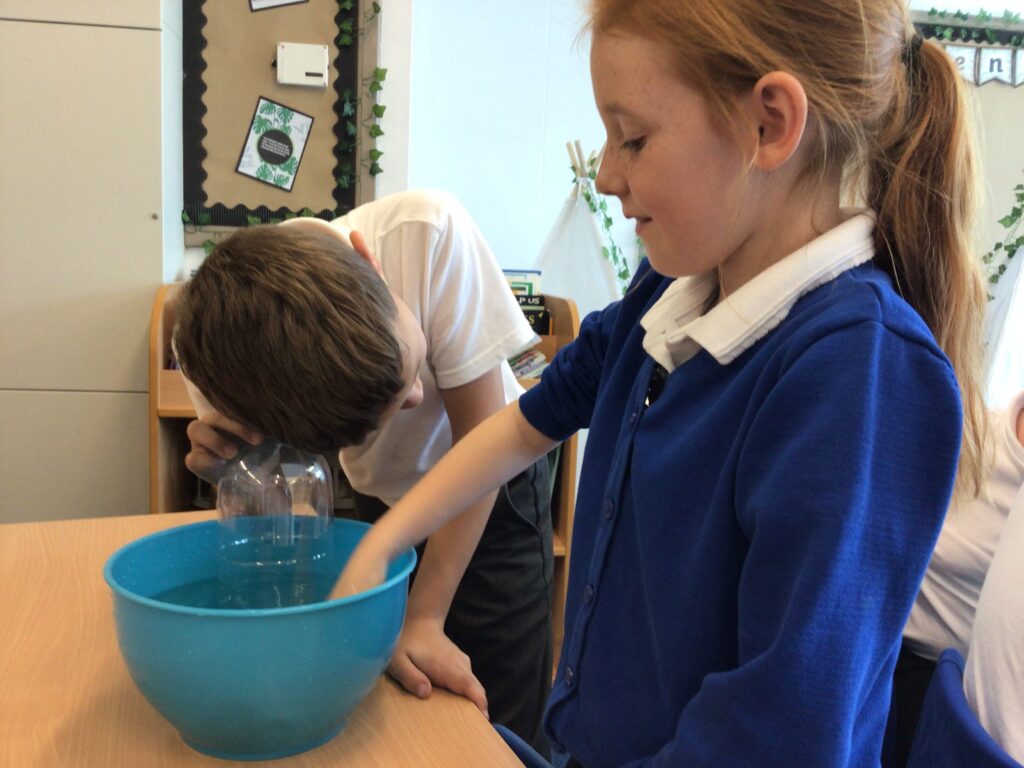

At Larkspur our science vision is to excite and stimulate curiosity in the minds of our young pupils through practical and engaging opportunities.  The enquiry based, informative and hands on learning we provide sparks discussion and fuels imagination, whilst developing knowledge and vocabulary.  Our children will acquire a back of core skills which will equip them for their future education and beyond. 

At Larkspur we try to incorporate the 5 lines of inquiry in the teaching of science.

Hazel

Early years science is about exploring and investigating the world, and about having fun and playing. Combining these two key elements, will establish a lifelong love of learning and investigation.  Science activities in the early years setting provides children with opportunities to develop and practice many different skills and attributes. These include communication skills, collaborative skills, team working and perseverance, as well as analytical, reasoning and problem-solving skills

Juniper

In Year 1 science lessons, the children learn about the importance of asking questions, gathering evidence, carrying out experiments and looking at different ways of presenting their results. Lessons are practical and focus on the world around them. Children will begin to learn the correct scientific vocabulary and use it correctly. 

Beech

In science we have been learning about plants.  We found that almost all plants need these five things to survive: 

  • Light
  • Air
  • Water
  • Nutrients 
  • Space to grow

We did an experiment to see what happens if seeds do not get all of the things they need.  This was very interesting. 

We also learned about all of the different stages of plant growth. 

Take a look at our amazing video!

Beech – Science in the Classroom

In Year 2 more work will be done to develop the core scientific skills of observation and investigation. The children work on a different topic each term, designed to encourage them to ask questions about the world around them, and they will be taught the importance of gathering evidence and carrying out experiments. They will begin to learn the importance of planning before they start a task. They will also be thinking of the best ways to present their results. 

Changes of State – Making Jelly

Static Electricity – Making something move without touching it

Birch

In lower KS2 the children will develop scientific knowledge and conceptual understanding through the specific disciplines of biology, chemistry and physics.  They will also develop understanding of the nature, processes and methods of science through different types of science enquiries that help them to answer scientific questions about the world around them.  The children will leave lower KS2 equipped with the scientific knowledge required to understand the uses and implications of science, today and for the future. 

Maple

In KS2 the children will develop scientific knowledge and conceptual understanding through the specific disciplines of biology, chemistry and physics.  They will also develop understanding of the nature, processes and methods of science through different types of science enquiries that help them to answer scientific questions about the world around them.  The children will leave lower KS2 equipped with the scientific knowledge required to understand the uses and implications of science, today and for the future. 

Elm

Science in upper KS2 will enable pupils to develop a deeper understanding of a wide range of scientific ideas. They do this through exploring and talking about their ideas; asking their own questions about scientific phenomena; and analysing functions, relationships and interactions more systematically. In upper KS2, they should encounter more abstract ideas and begin to recognise how these ideas help them to understand and predict how the world operates. They should also begin to recognise that scientific ideas change and develop over time. They should select the most appropriate ways to answer science questions using different types of scientific enquiry, including observing changes over different periods of time, noticing patterns, grouping and classifying things, carrying out comparative and fair tests and finding things out using a wide range of secondary sources of information. Pupils should draw conclusions based on their data and observations, use evidence to justify their ideas, and use their scientific knowledge and understanding to explain their findings.

Elder

Science in upper KS2 will enable pupils to develop a deeper understanding of a wide range of scientific ideas. They do this through exploring and talking about their ideas; asking their own questions about scientific phenomena; and analysing functions, relationships and interactions more systematically. In upper KS2, they should encounter more abstract ideas and begin to recognise how these ideas help them to understand and predict how the world operates. They should also begin to recognise that scientific ideas change and develop over time. They should select the most appropriate ways to answer science questions using different types of scientific enquiry, including observing changes over different periods of time, noticing patterns, grouping and classifying things, carrying out comparative and fair tests and finding things out using a wide range of secondary sources of information. Pupils should draw conclusions based on their data and observations, use evidence to justify their ideas, and use their scientific knowledge and understanding to explain their findings.

The 5 types of inquiry are:

  • Observation over time.
  • Pattern seeking.
  • Identifying, classifying and grouping.
  • Comparative and fair testing.
  • Research using secondary sources.